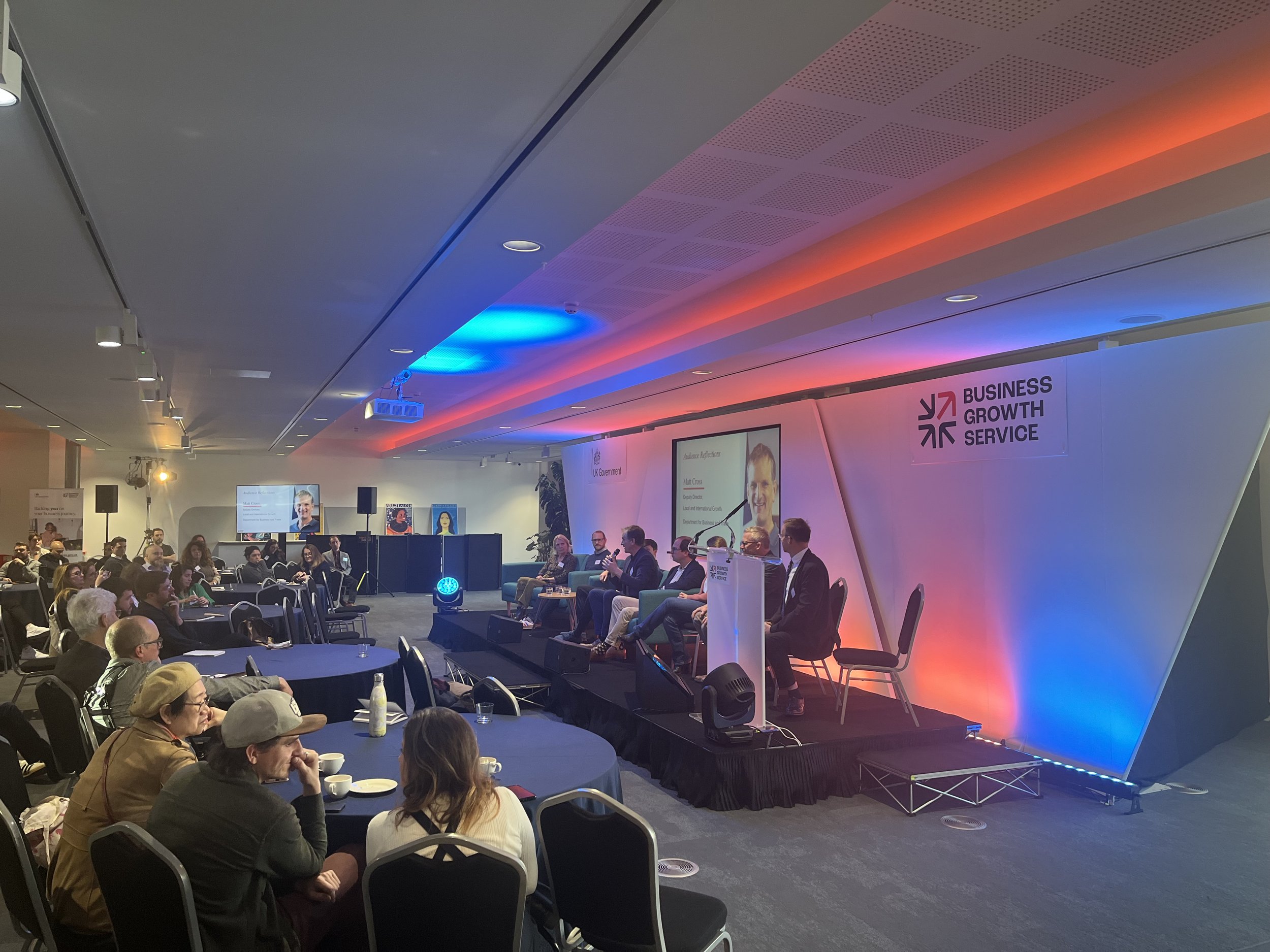
Bristol showed up for its SMEs this week. Not necessarily with grand promises or policy, but with something potentially more useful: candid chats about how we go about delivering growth.
The Business Growth Service Roadshow, held in Bristol and organised by the Department for Business and Trade and the West of England Mayoral Combined Authority (WECA), brought founders, policymakers and advisors from across the South West together to discuss the region’s growth potential.
The stats show the West of England is one of the most productive and values-driven business ecosystems in the country. It became the most productive Combined Authority area in England outside London in 2023 and also hosts more B Corps than anywhere else in the UK.
And when it comes to the region’s highest-growth sectors, WECA’s growth strategy has zeroed in on:
Advanced manufacturing
Digital technologies
Clean energy
Creative industries
The everyday economy
Against that backdrop, the conversation was less about policy and more about practical steps the SMEs in the room can take to grow, adapt and translate their potential into economic impact.
Here's what stood out…
Mind the translation gap!
Professor Matt Freeman of Future Space Bristol put his finger on the central challenge facing innovative SMEs: the translation gap. Between a promising idea and commercial impact sits the "valley of death", the point where R&D stalls, momentum fades away and potential is missed.
It's a problem that Future Space is well placed to solve. Part of UWE, Matt’s team brings together research, space, talent and industry under one roof.
The approach gets the right people in the right environment to close the gap between discovery and impact, an engine turning innovation into something that can scale.
The following fireside chat explored how the South West’s SMEs are turning the challenge of the translation gap into opportunity:
Despite coming from very different sectors, their experiences shared the view that growth journeys are rarely straightforward. False starts and dead ends are all part of the process. but what separates those who make it is the ability to translate ideas into practical and scalable outcomes.
AI’s role in delivering growth
A lot of the room's energy centred on AI, which is hardly surprising. But the conversation was more grounded than you might expect and all the more useful for it.
Matt suggested the real value in AI comes when it’s embedded across workflows, with rigorous testing and being honest about when it goes wrong. He said a spirit of curiosity and experimentation with AI should be spread across teams, not just concentrated in one corner of a business.
He also addressed how the rise of the tech is making human skills more valuable. Soft, human-centric skills of adaptability, communication and critical thinking are becoming more valuable precisely because of AI. He said: “Those who can take new tools and make them genuinely useful in practice are the ones in demand.”
No business grows in isolation
Nick Sturge MBE, founder, non-executive and West of England Board member, brought insight from decades of experience at the helm of businesses across the region.
On building the right teams, he highlighted how growth changes your role as a founder, but that rarely happens naturally or comfortably. He advised being honest about where your strengths end, then hire people who fill what's missing in the direction you want to go.
He also suggested founders shouldn’t wait too long to bring in outside help. "Hiring a non-exec early was a game changer for us".
On networks, a stat which stood out was businesses which actively seek external support see around a 22% uplift in productivity. It shows that going it alone can be one of the most common and costly mistakes a founder makes.
The good news is that the South West region has a strong support network, with accelerators, peer networks and advisors, alongside more national programmes like the Government’s new Business Info Service.
The fundamentals remain
For all the discussion surrounding AI, sector strategies, government policy and support, Nick made sure the room didn't drift too far from fundamentals.
"The best form of finance is sales."
It sounds obvious, but it’s also the thing most easily forgotten when a new technology or funding opportunity creates a flurry of excitement. Revenue is the foundation everything else is built on and when the hype around a trend fades, it's the fundamentals that are left behind.
It's a useful reminder, particularly for tech founders in a region with clout when it comes to innovation.
What it comes down to
The recurring theme across the morning was that of translation, the ability to turn insight into action, innovation into commercial viability and complexity into something your customers actually want.
It's about building teams with the right mix of skills, staying connected to the networks around you and resisting the temptation to mistake activity for progress.
For Bristol's SMEs, the good news is that the region’s ecosystem is in a strong position. It has the universities, the talent, the infrastructure, the values-driven culture and the institutional support to help founders grow.
The challenge will be whether they can capitalise on these opportunities in a challenging economic environment.