Field Notes 01: How innovation sectors can use BOFU content to influence and convert buyers, investors and advocates.
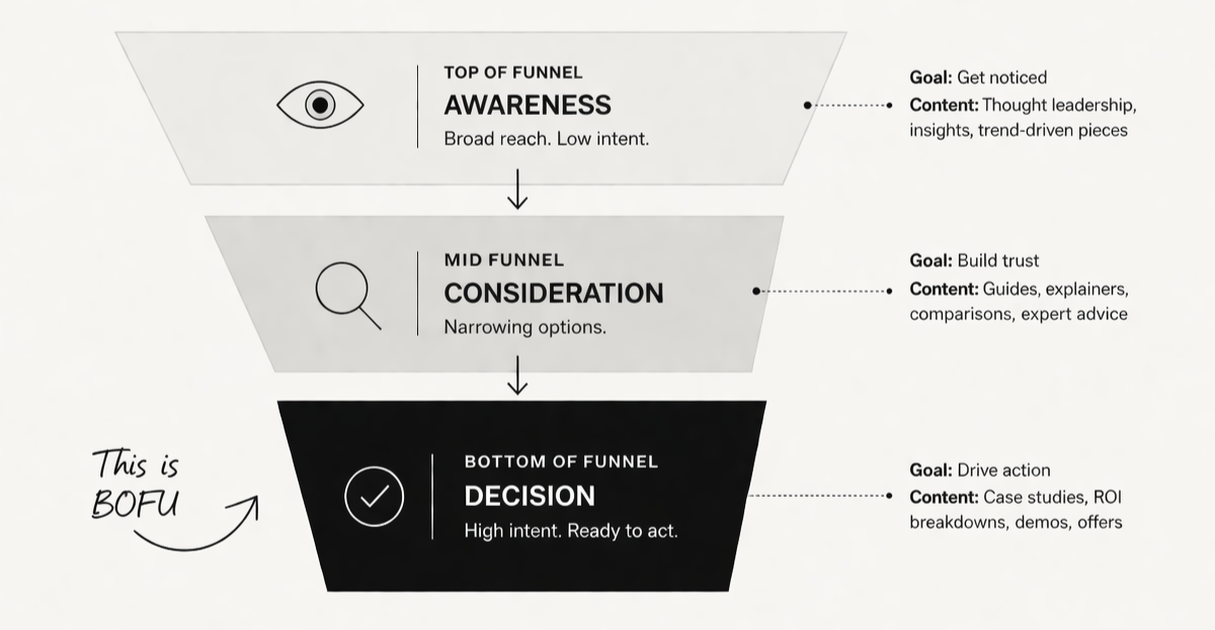
The content marketing funnel
The idea behind a content funnel is as simple as it is well-trodden part of the marketing mix. It guides prospective customers through a decision over time.
It's a well-established framework because it also works. You build broad awareness with content at the top of the funnel, deepen interest in the middle and narrow your focus at the bottom to those most likely to act.
The problem is most content strategies lean heavily on the top of funnel content, (thought leadership, opinion pieces and articles) and often fall short of making it to the bottom of the funnel where decisions happen.
What is BOFU content?
Bottom of funnel content, or BOFU for short, is aimed at the narrowest part of the marketing funnel. It targets those who aren’t simply exploring a service, product or a topic, but are educated buyers ready to commit and convert.
They're weighing up their options and comparing providers before they sign up to a service or buy a product. At this stage they want to understand whether the product is the right fit, whether it's worked for organisations like theirs in the past and what onboarding would look like in practice.
That's a world away from content which builds awareness and needs a fundamentally different approach.
You've probably come across a few examples of BOFU content marketing:
Comparison guides: side-by-side feature, pricing or service comparisons that help customers evaluate options.
Case studies: stories that show impact, measurable outcomes and return on investment from existing clients.
Testimonials and reviews: third-party evidence that builds confidence in the product or service.
Pricing pages and calculators: clear pricing information or tools to help prospects understand cost and value before they sign up.
Onboarding guides: step-by-step explainers that show what working with you will actually look like, removing friction for the final decision.
Free trials or demos: the opportunity to experience a solution before committing, often paired with guidance or best practice content.
The common thread between these examples is that they're written for those who are nearly ready to act.
That means the content has to get to the point quickly. It should cut through marketing fluff, be specific about outcomes and makes the next step obvious.
What innovation sectors can learn from BOFU
Sectors like SaaS and financial services have been running sophisticated BOFU strategies for years. With long sales cycles, high-consideration products and intense competition, the companies have got BOFU content down to an art form.
BOFU isn’t as evident in more B2B comms and innovation-focused sectors, but organisations have just as much to gain from it. Industry data consistently shows BOFU content converts at rates ten times or more higher than top of funnel content.
Whether in life sciences, deep tech, energy or infrastructure, this could make the difference between bringing your product to market or securing investment.
Across these sectors, the stakes are high, the decisions are complex and the buying cycles are drawn out, which makes the case for using content to reduce friction and uncertainty at the decision stage even more compelling.
Examples of BOFU content for innovation sectors:
Infrastructure projects: clear briefing materials, targeted case studies and process explainers that directly address decision-makers' concerns.
Innovation campuses and science parks: company profiles, technology showcases and detailed onboarding guides that help investors and occupiers understand exactly what engagement looks like.
Life sciences investment decisions: clinical trial summaries, impact case studies and comparative analysis of technologies that help boards and investors make funding decisions.
Deep tech: proof-of-concept reports, implementation guides and lessons learned from early adopters that reduce uncertainty for potential clients.
Energy and sustainability: feasibility studies, ROI calculators and evidence-based success stories that reassure commercial or governmental decision-makers before they commit.
In each of these examples, the content has a specific job: to reduce uncertainty and friction as much as possible at the moment it matters most.
Where to start
If your marketing strategy is light on decision-stage BOFU content, you probably have more to work with than you think.
Start with your sales process and pipeline. The questions that come up repeatedly in the final stages of a deal are essentially a brief waiting to be written.
How long will it take for me to implement the technology?
What objections surface most often?
What do prospects ask before they commit?
Answer these questions properly and you have the basis of a BOFU content strategy.
It's also worth auditing what you already have across your business. Proposals, case studies, onboarding documents and internal FAQs can be really useful materials that could be shaped externally into useful content with relatively little effort. It just hasn't been packaged up for the right audience.
When it comes to the format of BOFU content, you should keep it concise and focused. Case studies should be drafted with real outcomes, with comparison guides, process explainers and clear next steps. You should ask yourself whether the content is removing doubt at the point where it matters most.
And prioritise quality over quantity. Three well-written, specific BOFU pieces will deliver far better ROI than a dozen generic blog posts.
A shift in mindset
The most useful approach would be to stop thinking about your content mix purely in terms of reach or awareness and start thinking about outcomes you want and where friction occurs in your customer’s buying or decision making process.
A piece that attracts ten thousand readers who aren't even close to making a decision will almost always underperform compared to one that reaches a few dozen people who are poised and ready to commit.
Our approach
You want to ask yourself whether your marketing mix is generating attention but not necessarily driving the outcomes you’re looking for.
Fieldcraft works with organisations across life sciences, infrastructure, energy and innovation to develop content that drives commercial outcomes.
Whether that means building case studies, sharpening decision-stage messaging or developing a content strategy around your sales pipeline, the starting point is usually a quick conversation.